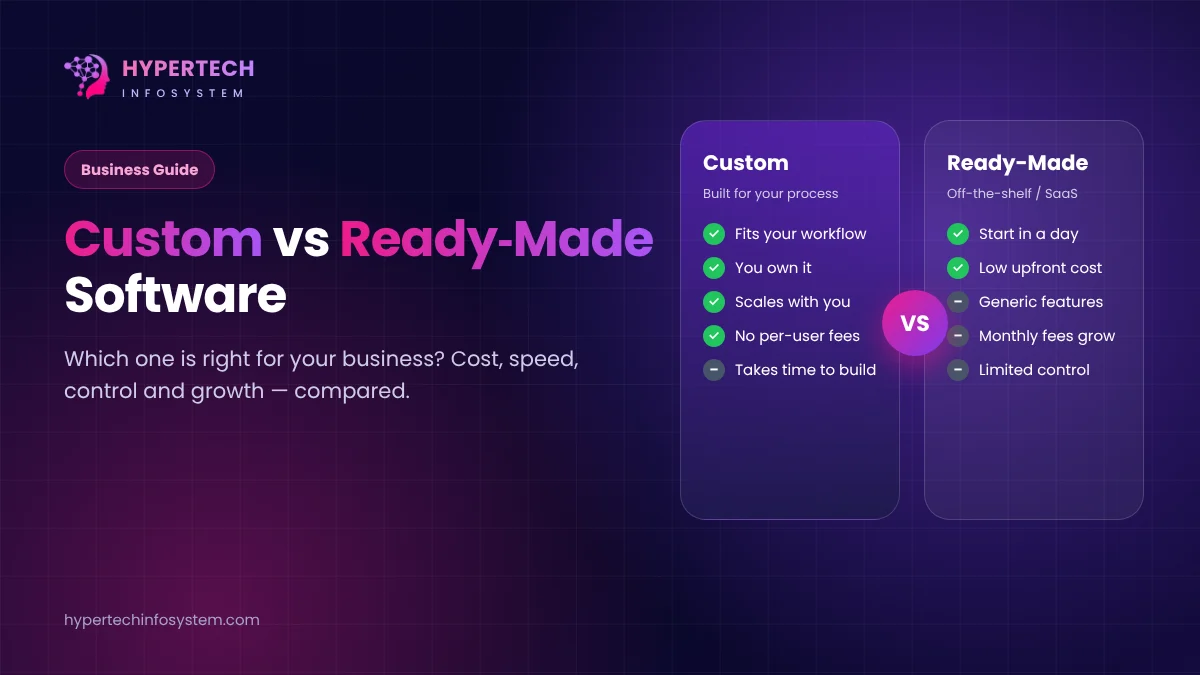
Every growing business reaches a point where Excel sheets, WhatsApp groups and manual registers are no longer enough. The next question is: should we buy ready-made software, or build custom software for our business? Both are good options — for different situations. This guide compares them honestly so you can make the right decision.
What is ready-made software?
Ready-made (off-the-shelf or SaaS) software is a product built for thousands of businesses — for example common accounting, CRM, HRMS or billing tools. You sign up, pay a monthly or yearly fee per user, and start using it quickly.
What is custom software?
Custom software is built specifically for your processes — your workflow, approvals, reports, user roles and integrations. Examples include a school or exam management system, a distributor ordering app, a factory ERP or a CRM designed around how your sales team actually works.
Custom vs ready-made: the key differences
1. Cost
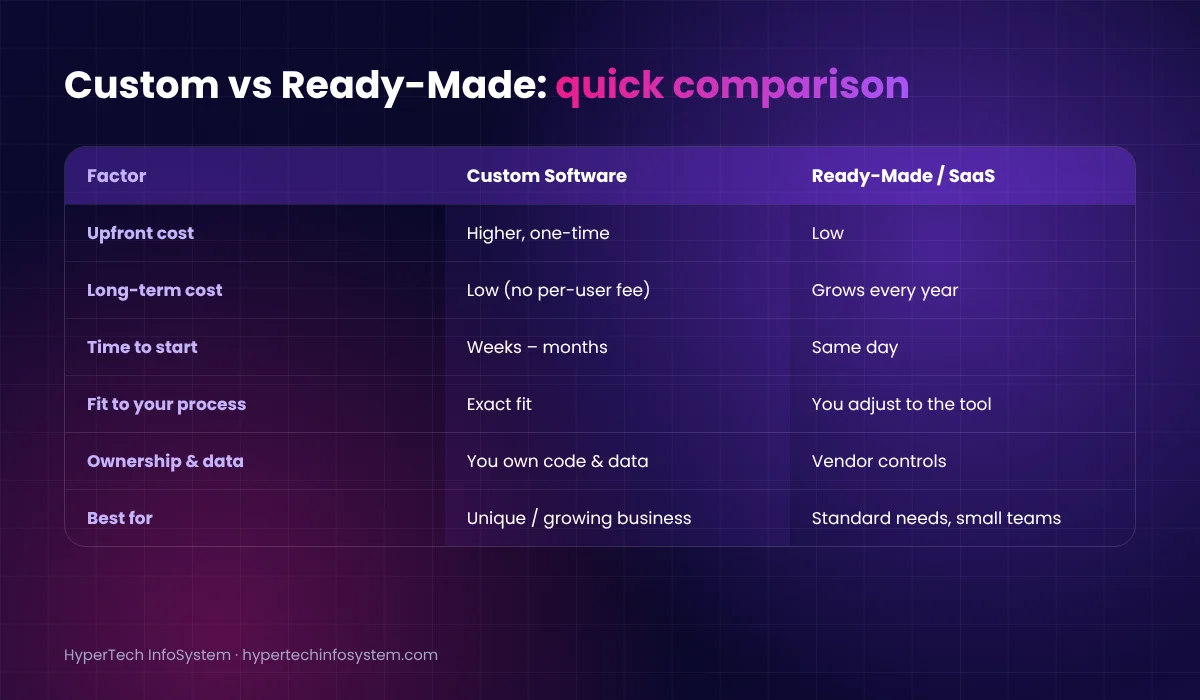
Ready-made software has a low upfront cost, but you pay every month, often per user. Custom software has a higher one-time cost but no per-user licence fee. For example, a tool that costs ₹800 per user per month for 25 users means about ₹2.4 lakh every year — around ₹12 lakh over five years, and it keeps increasing as your team grows.
2. Fit to your process
With ready-made tools, your team adjusts to the software. With custom software, the software follows your process — fewer workarounds, fewer manual steps and fewer errors.
3. Speed to start
Ready-made wins here: you can start the same day. Custom software takes weeks to months, depending on the scope. A phased approach (launch core modules first) reduces this wait.
4. Ownership, data and control
With custom software you own the source code and decide where your data is stored, who can access it and how it is backed up. With SaaS, the vendor controls pricing, features and sometimes data export.
5. Scalability and integrations
Custom software can grow with new modules, branches and integrations (payment gateways, GST, WhatsApp, Tally, biometric devices, mobile apps) exactly when you need them. Ready-made tools offer what is on their roadmap — not always what you need.
6. Competitive advantage
If every competitor uses the same tool, nobody has an edge. A unique process built into your own software — faster quotations, better customer experience, smarter reports — can become a real advantage.
When should you choose ready-made software?
- Your needs are standard (basic accounting, email, simple invoicing).
- You are a small team and need to start immediately.
- Your budget for this year is very limited.
- A popular tool already covers 90% of what you need.
When should you choose custom software?
- Your process is unique and ready-made tools need too many workarounds.
- Per-user fees are becoming expensive as your team grows.
- You need several systems to talk to each other (website, app, ERP, CRM, payments).
- You want full ownership of your software and data.
- The software itself is part of your product or service to customers.
The smart middle path
Many businesses use a hybrid approach: ready-made tools for standard work (like accounting) and custom software for the core process that makes them money — connected through APIs. Others start with an MVP of custom software and add modules every few months. This keeps the first investment small and the risk low.
A quick 5-question checklist
- Do ready-made tools force us into manual workarounds every day?
- Will our per-user software bill be high in 3–5 years?
- Do we need our website, app, CRM and accounts to share data automatically?
- Is our process a key reason customers choose us?
- Do we want to own our software and data?
If you answered “yes” to three or more, custom software is very likely the better long-term investment.
How HyperTech InfoSystem can help
HyperTech InfoSystem builds custom software, ERP, CRM, HRMS and web/mobile applications for growing businesses — and also offers ready-to-use products where they fit better. We first study your process, then suggest the most cost-effective option — custom, ready-made or a mix. Read our guide on mobile app development cost in India, explore our services, or book a free consultation.
Frequently asked questions
Is custom software expensive?
The upfront cost is higher, but there are no per-user licence fees. Over 3–5 years, custom software is often cheaper for growing teams — and it fits your process exactly.
How long does custom software take to build?
Small tools can go live in a few weeks; larger ERP or CRM systems take a few months. Launching in phases lets you start using core modules early.
Will I own the source code?
With HyperTech InfoSystem, ownership of the project source code is transferred to you after full payment, as clearly written in our quotation.
Not sure which option is right for you? Talk to our experts — we will give you an honest recommendation.
0 Comments
No comments yet. Be the first to share your thoughts!
Leave a Comment
Your email will not be published. Comments appear after approval.