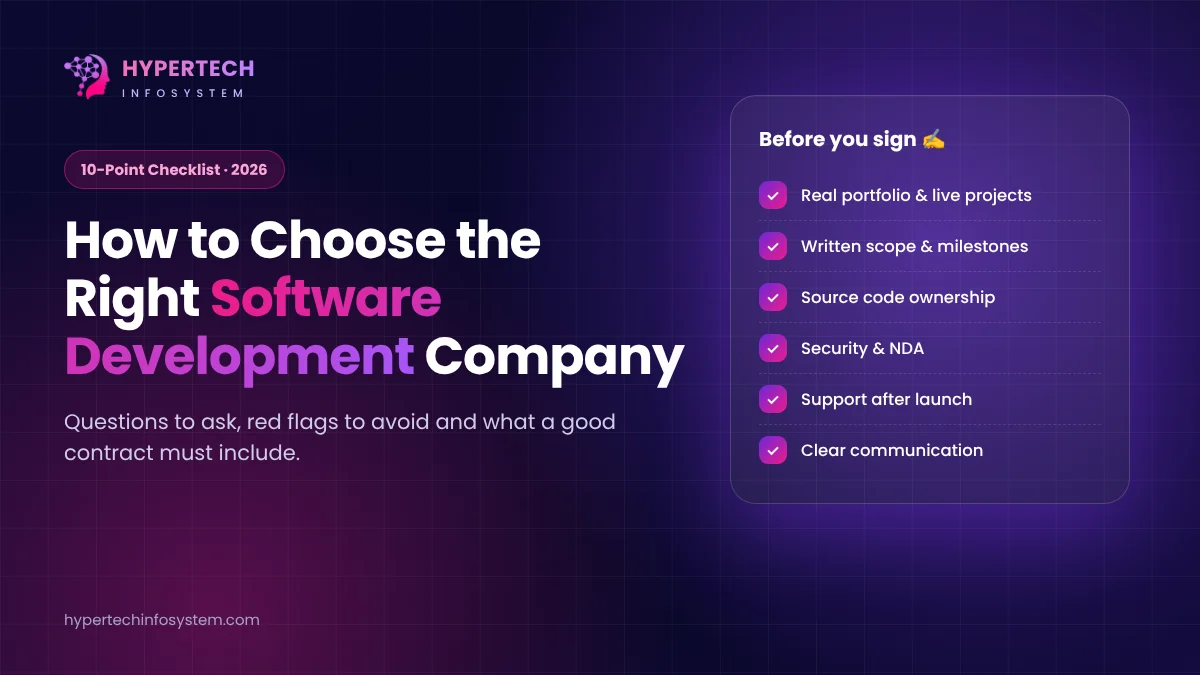
Choosing a software development partner is one of the most important decisions for any growing business. The right team turns your idea into a reliable product on time; the wrong one can cost you months, money and peace of mind. Whether you need a website, mobile app, CRM or ERP, this 10-point checklist will help you compare companies with confidence — before you pay any advance.
Before you start: be clear about what you need
Write a one-page brief: what problem the software solves, who will use it (customers, staff, vendors), the 5–10 most important features, any existing tools it must connect to, your expected budget range and deadline. A clear brief gets you accurate quotes and makes it easy to compare companies fairly.
The 10-point checklist
1. A real portfolio with live projects
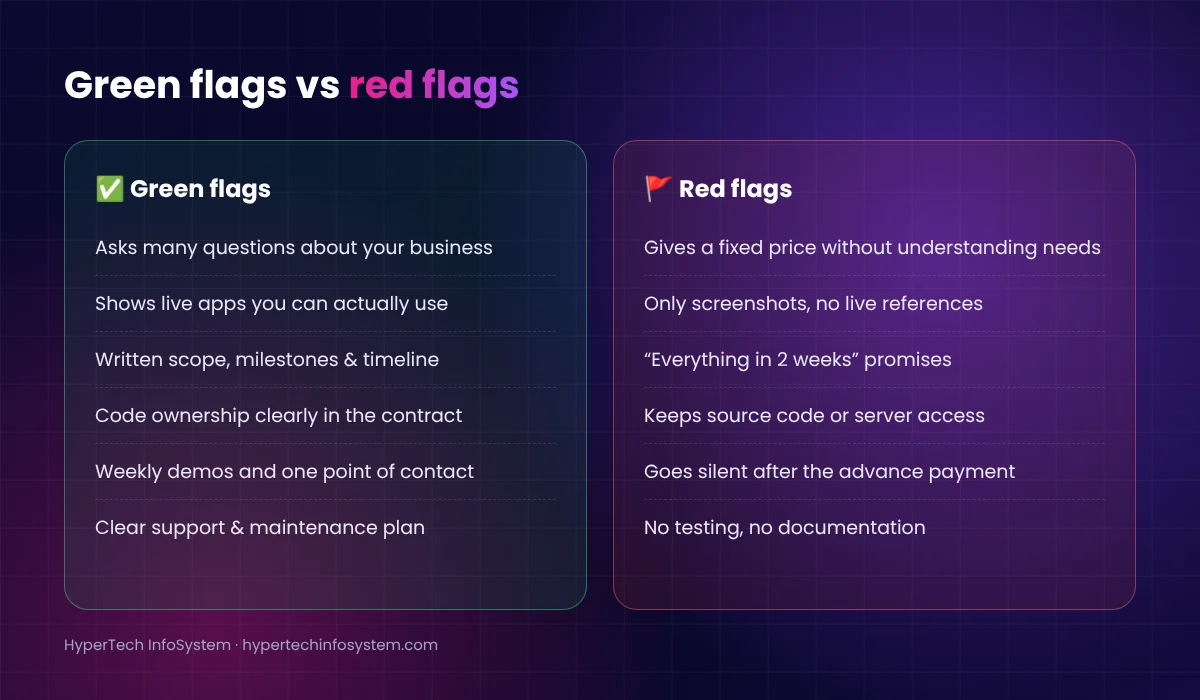
Screenshots are easy to copy. Ask for live websites, Play Store / App Store links or demo logins you can actually use. Check speed, design quality and whether the apps are still maintained.
2. Experience in your type of project
A team that has built booking systems, school ERPs or e-commerce platforms before already understands common problems in that area. Ask: “Have you built something similar? What did you learn from it?”
3. They ask the right questions
A good company asks many questions about your business, users and goals before giving a price. If someone sends a fixed quote within an hour without understanding your needs, the price will usually change later.
4. A written scope, timeline and milestones
Insist on a written proposal or quotation listing features, screens, deliverables, timeline and payment milestones (for example: advance → design approval → development → testing → launch). Paying against milestones protects both sides.
5. Source code and data ownership
Your contract should clearly say that source code, design files and data belong to you after full payment, and that you will receive server, domain and app-store access. Avoid vendors who keep everything in their own accounts.
6. Technology that fits your future
Ask why they recommend a particular technology. Popular, well-supported stacks (like Laravel/PHP, Node.js, React, Flutter) make it easier to hire developers and scale later. Be careful with outdated or “secret in-house” platforms that lock you in.
7. Security and confidentiality
Your idea and business data deserve protection. A professional company signs an NDA, follows secure coding practices, uses HTTPS, protects passwords and personal data, and takes regular backups.
8. Communication and transparency
Check how quickly and clearly they reply during the sales stage — it rarely improves later. Ask for one point of contact, weekly updates and demos, and access to a test link where you can see progress.
9. Testing and quality process
Ask how they test: on which devices and browsers, who tests, and how bugs are tracked. Real testing before launch saves you from angry customers after launch.
10. Support and maintenance after launch
Software needs updates, security fixes and small changes. Confirm the free support period, response time for urgent issues and the cost of an annual maintenance plan (AMC) before you start.
Questions to ask in your first meeting
- Can you show us 2–3 live projects similar to ours?
- Who will work on our project, and who is our main contact?
- How will you share progress, and how often?
- What exactly is included in the price, and what is extra?
- Will we own the source code, and get all server and account access?
- What happens if a feature takes longer than planned?
- What support do you give after launch, and for how long?
Red flags to avoid
- A very low price with no clear list of features.
- Promises like “complete app in 2 weeks” for a large project.
- No written agreement, or 100% payment upfront.
- No live references or client reviews.
- The vendor wants to keep your code, domain or app-store account in their name.
Cheapest is not always the lowest cost
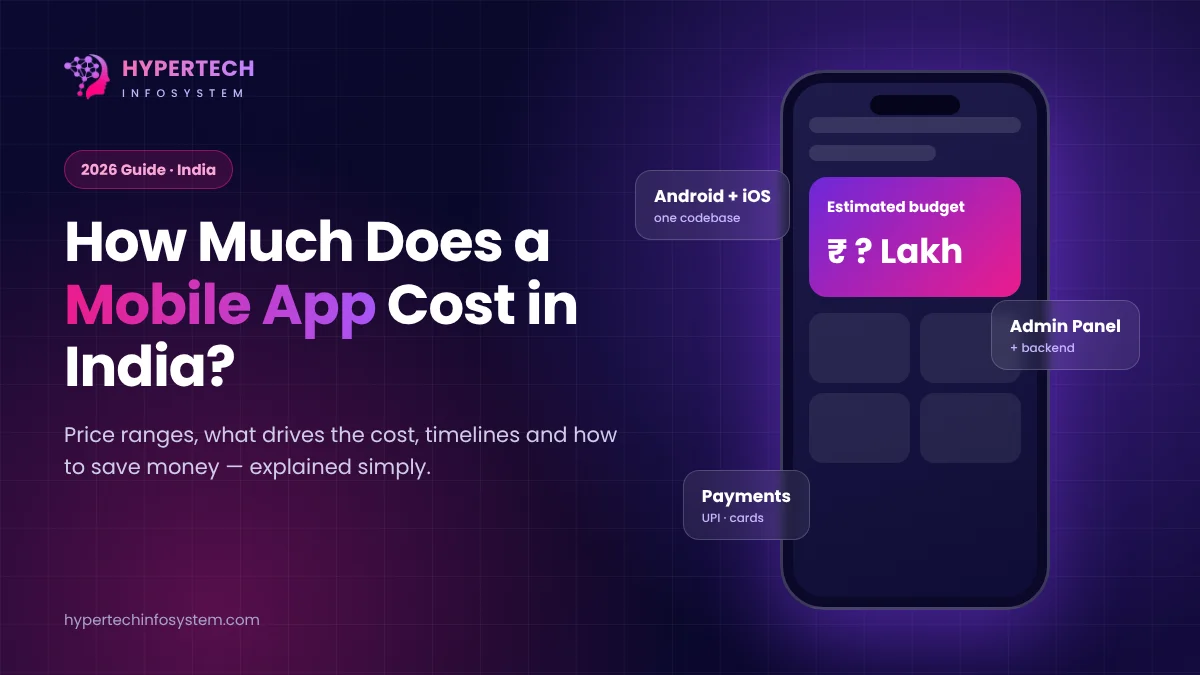
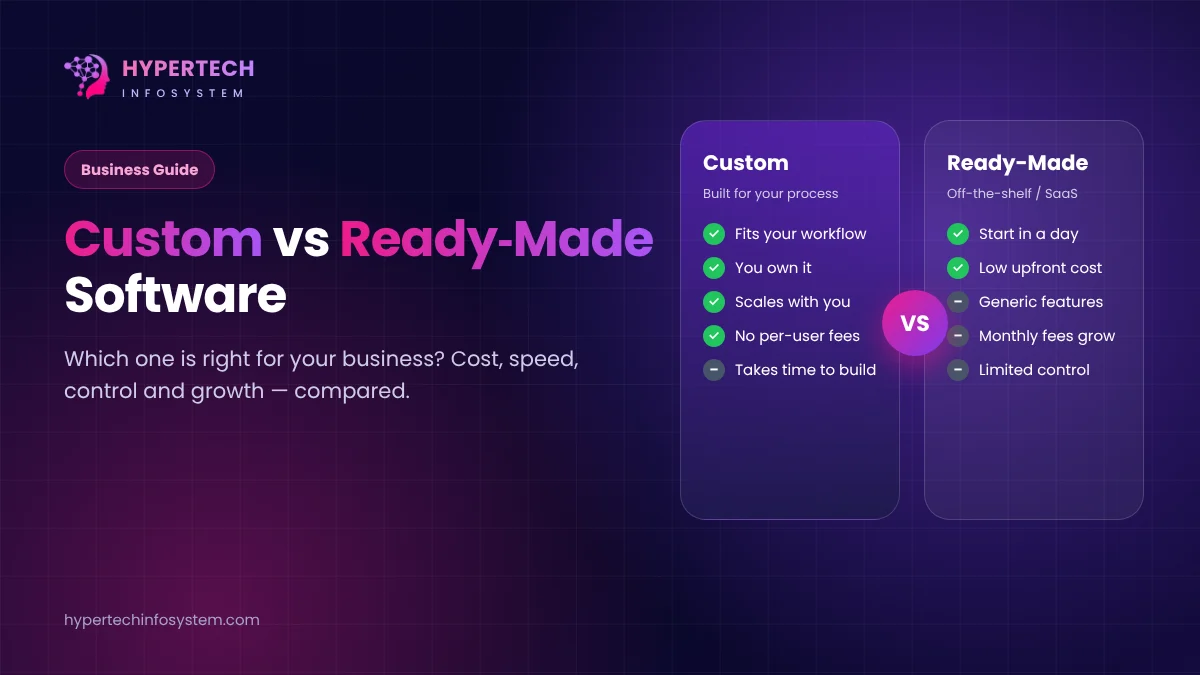
A low quote that needs to be rebuilt after a year is the most expensive option. Compare companies on value: understanding of your business, quality of past work, clarity of the contract and long-term support — not only the first price. If you are planning an app, our guide on mobile app development cost in India explains realistic budgets, and custom vs ready-made software helps you choose the right approach.
Why businesses choose HyperTech InfoSystem
HyperTech InfoSystem builds websites, mobile apps, CRM, ERP and custom software for growing businesses in India and abroad. Every project starts with understanding your process, followed by a clear written quotation with milestones, NDA on request, weekly demos and full code ownership after payment. See our portfolio and services, or talk to our team.
Frequently asked questions
Should I choose a freelancer or a software company?
Freelancers can be good for small, well-defined tasks. For business-critical software you usually need design, development, testing and support together — a company gives you a team, continuity and accountability.
How much advance should I pay?
A common practice is 20–40% advance, with the rest linked to milestones such as design approval, development completion and launch.
Is an NDA necessary?
If your idea, data or process is sensitive, yes. A professional company will happily sign a mutual NDA before you share details.
Planning a new project? Get a free consultation — we will review your idea and share an honest plan, timeline and estimate.
0 Comments
No comments yet. Be the first to share your thoughts!
Leave a Comment
Your email will not be published. Comments appear after approval.