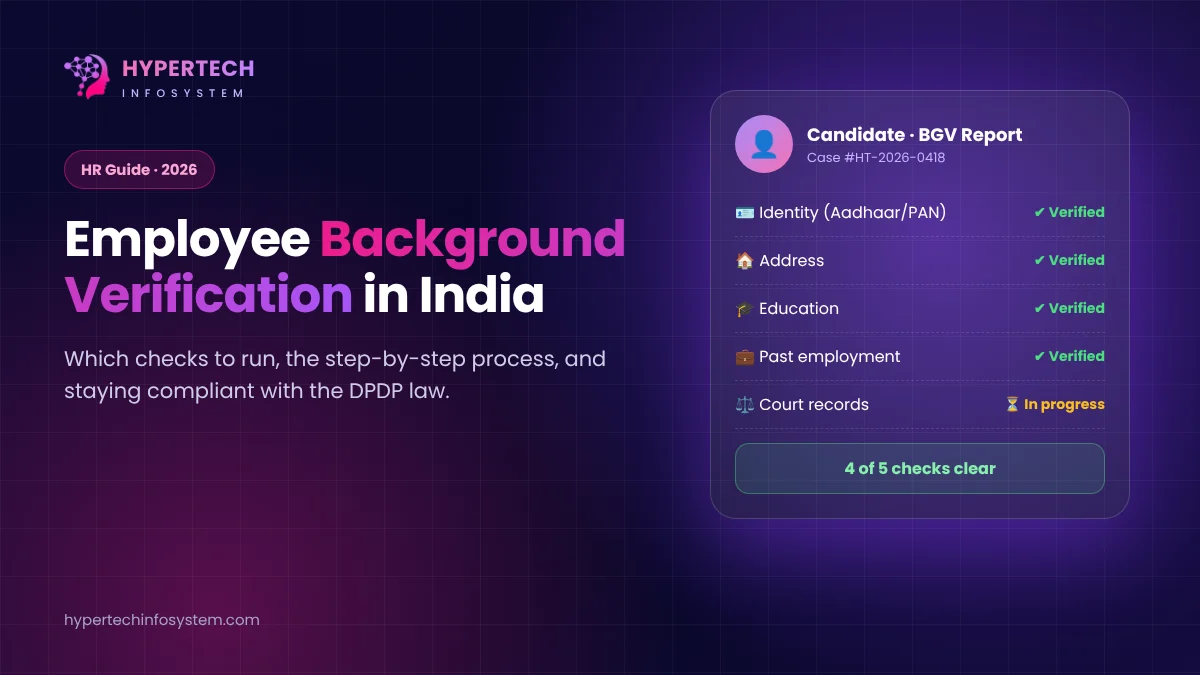
A polished resume and a great interview do not always tell the full story. Fake experience letters, inflated job titles, unverifiable degrees and undisclosed court cases are more common than most employers think. Employee background verification (BGV) helps you confirm that a candidate is who they say they are — before you hand over customer data, cash, company devices or a leadership role.
Why background verification matters
- Discrepancies are common: AuthBridge’s Workforce Fraud Files 2025 (Oct 2024–Mar 2025 data) found a discrepancy rate of about 6% for white-collar hires, with sector rates of around 11.7% in BFSI and 16% in pharma. Its H1 FY26 update reported about 4.3% for white-collar and 5.6% for gig workers.
- Bad hires are expensive: the same report estimates that a bad hire can cost up to one-third of the employee’s first-year salary — before counting damage to clients and reputation.
- Regulation and client trust: banks, NBFCs, fintechs, healthcare and IT services companies are often required by regulators or clients to screen employees.
- Safety: for delivery staff, drivers, caregivers and field workers, verification protects your customers at their doorstep.
Common types of background checks
- Identity: Aadhaar (masked or offline e-KYC), PAN, passport or voter ID, matched with the candidate’s photo.
- Address: current and permanent address — digital (geo-tagged) or physical visit.
- Education: degrees and mark sheets confirmed with the university or board, or through DigiLocker.
- Employment history: past employers, designation, tenure and exit reason, confirmed with HR — often the check with the most discrepancies.
- Court and criminal records: court record searches and, where appropriate, police verification.
- Reference checks: conversations with former managers.
- Role-specific checks: credit history for finance roles, driving licence for drivers, professional licences for doctors or CAs, and dual-employment checks for remote roles.
Match the depth of checks to the role. A finance controller needs far more checks than an intern — and collecting less data is also safer under the new privacy law.
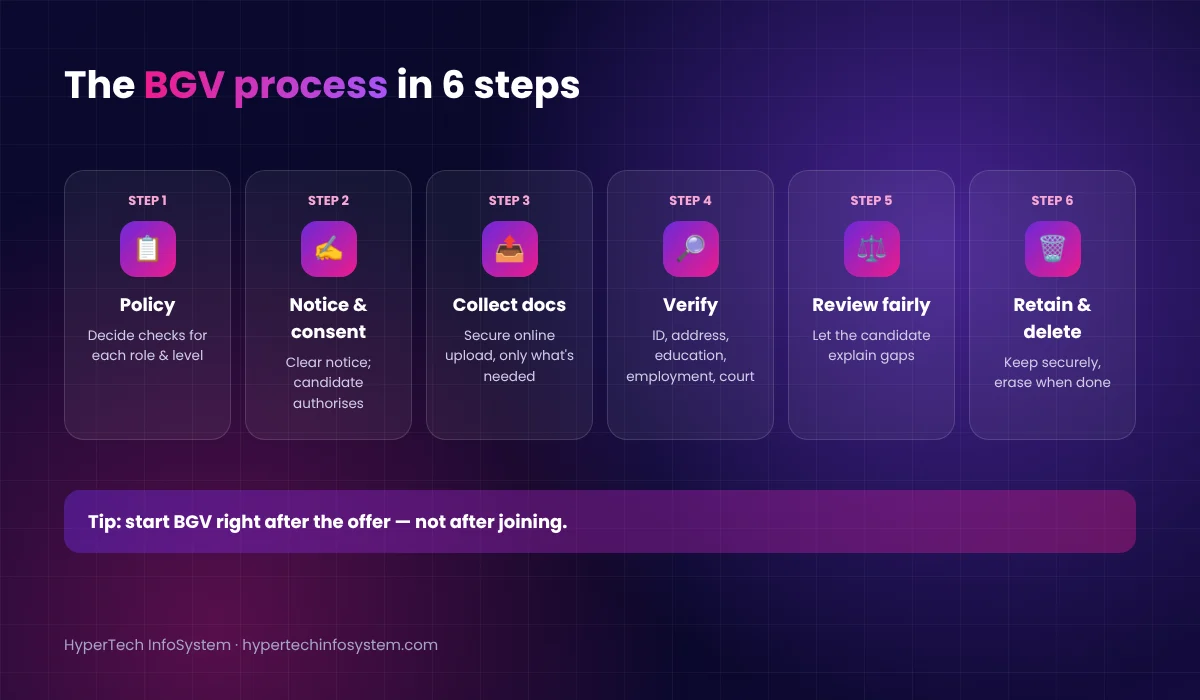
A simple 6-step BGV process
- Write a BGV policy: decide which checks apply to which roles, who handles results and timelines.
- Give clear notice and take authorisation: tell the candidate what will be checked, why, and who will do it (your team or a verification agency).
- Collect documents securely: use an online form or HR portal instead of WhatsApp or personal email, and ask only for what you need.
- Run the checks: in-house or through a trusted verification partner; track every case on one dashboard.
- Review fairly: if something does not match, give the candidate a chance to explain before deciding. A short gap or a typo is not the same as a forged certificate.
- Retain and delete: store reports with limited access and erase data when it is no longer needed.
BGV and India’s new data protection law (DPDP)
The Digital Personal Data Protection Act, 2023 and the DPDP Rules, 2025 (notified by MeitY in November 2025) apply to the personal data employers collect during hiring. Most core obligations come into force in phases, with the main compliance duties applying from May 2027 — so 2026 is the year to get ready. Key points for HR teams:
- Lawful basis: the Act allows certain processing for employment purposes as a “legitimate use”, but many employers still take clear written authorisation for BGV as good practice — especially for candidates who are not yet employees.
- Notice: explain in simple language what data you collect and why.
- Purpose and data minimisation: collect only what the role requires and use it only for verification.
- Verification agencies are “data processors”: sign a proper contract covering security, confidentiality and deletion.
- Security safeguards: encryption, access control, logs and backups — and a process for reporting data breaches.
- Rights of individuals: people can ask to access, correct or erase their data, and must have a way to raise grievances.
This is general information, not legal advice. Please confirm your policy with your legal advisor.
How long does BGV take, and what does it cost?
Digital checks such as identity and PAN can be completed within minutes. Education, employment and address checks typically take 3–10 working days, depending on how quickly universities and past employers respond. Costs vary by package — a basic bundle (ID + address + one employment) costs far less than a full senior-level package with court, credit and multiple references. Ask vendors for a per-check price list and turnaround times.
Best practices
- Start BGV right after the offer is accepted, not weeks after joining.
- Make the offer letter clearly conditional on satisfactory verification.
- Use one digital platform for forms, documents, tracking and reports — no scattered spreadsheets.
- Re-verify periodically for sensitive roles (finance, cash handling, data access).
- Treat every candidate consistently and keep a record of decisions.
Make BGV faster with Shigotoplus
Shigotoplus by HyperTech InfoSystem is a recruitment & HR platform with job posting, candidate search, BGV & verification and workforce management in one place. HyperTech also builds custom HRMS and onboarding portals with secure document upload, consent capture and verification tracking. Book a free demo or contact our team.
Frequently asked questions
Is background verification legal in India?
Yes. Employers commonly verify candidates, but they must handle personal data lawfully — with clear notice, purpose limitation and security, as required under the DPDP framework.
Can a candidate refuse background verification?
A candidate can refuse, but the employer can make the job offer conditional on successful verification, as long as this is stated clearly in advance.
Should we verify freelancers and gig workers too?
Yes, especially when they visit customers, handle goods or cash, or access company systems. Lighter, faster digital checks work well for these roles.
Want to digitise hiring and verification? Book a meeting with HyperTech InfoSystem.
Sources: AuthBridge, “Workforce Fraud Files 2025” and “Workforce Fraud Files – H1 FY26”; Ministry of Electronics and IT, Digital Personal Data Protection Act 2023 and DPDP Rules 2025 (notified November 2025).
0 Comments
No comments yet. Be the first to share your thoughts!
Leave a Comment
Your email will not be published. Comments appear after approval.