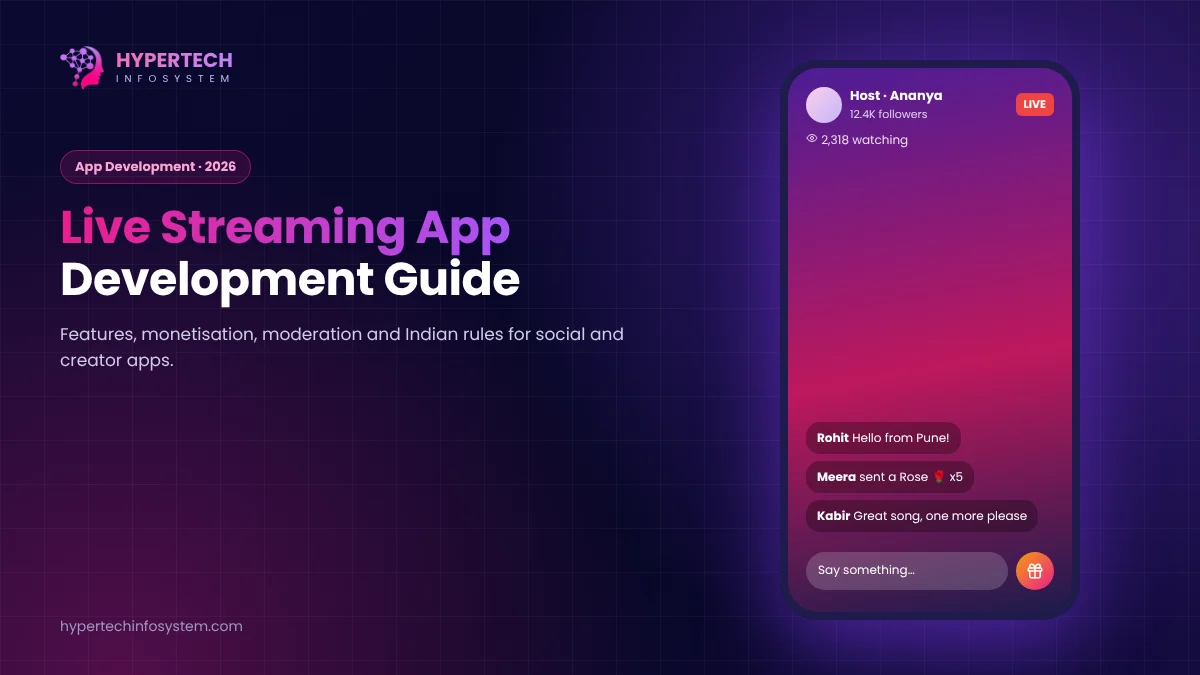
Live streaming is no longer only for gamers and celebrities. Creators host talk shows, sellers run live shopping, coaches teach live classes and friends hang out in audio rooms. If you are planning a streaming or social app, this guide covers what goes into building one that people actually return to.
How a live streaming app works
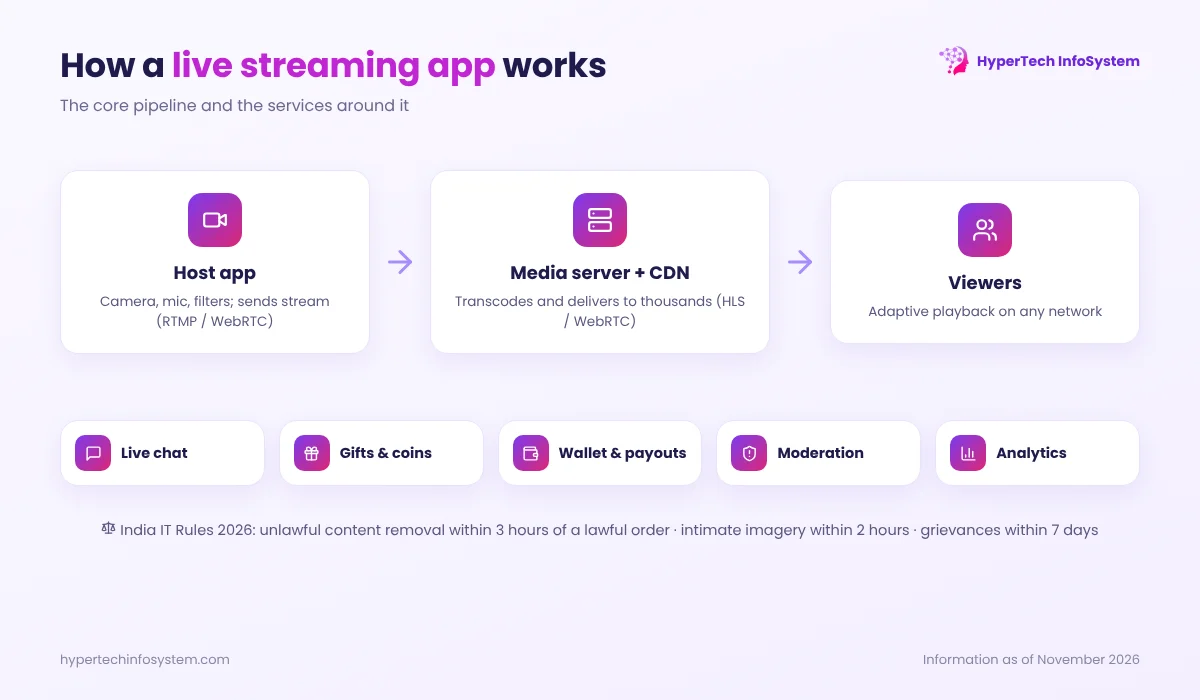
A broadcaster’s phone captures video and sends it to a media server. The server processes it and pushes it through a content delivery network (CDN) to viewers. For one-to-many streams with a few seconds’ delay, protocols such as RTMP for ingest and HLS for playback are common. For real-time interaction such as co-hosting, PK battles, video calls or audio rooms, WebRTC keeps the delay to well under a second. Around this sit the services that make it a product: chat, gifts, wallet, notifications, moderation and analytics.
Features users expect
For viewers
- Fast discovery: trending, nearby, following and categories
- Smooth playback that adapts to slow networks
- Live chat, reactions and virtual gifts
- Follow, notifications when a favourite host goes live, replays
For hosts
- One-tap go-live with beauty filters and good audio
- Co-hosting, guest invites and multi-host rooms
- Earnings dashboard and easy withdrawals
- Tools to mute, block and remove abusive viewers
For the admin team
- Real-time moderation queue, reports and bans
- Gift catalogue, pricing and offers management
- Host verification (KYC) and payout approvals
- Revenue, retention and top-host reports
How streaming apps make money
- Virtual gifts and coins: viewers buy coins and send gifts, and hosts receive a share. This is the main revenue model for most social streaming apps.
- Subscriptions and VIP levels: badges, special entry effects, ad-free viewing.
- Paid private calls or rooms with hosts.
- Ads and brand sponsorships once you have scale.
- Live commerce: products pinned during a stream with direct checkout.
App store billing matters here. Google Play requires its billing system for in-app purchases of digital goods such as virtual currency, and Apple has similar rules. In India, Google also offers user choice billing, which lets eligible developers show an alternative billing option alongside Play’s at a slightly reduced service fee. Budget for these fees from day one; they affect your gift pricing and host payouts.
Safety, moderation and Indian law
A live app is an intermediary under India’s IT Rules, and the IT Amendment Rules, 2026 (notified February 2026) tightened obligations significantly:
- Content flagged by a court or authorised government order must be removed within 3 hours (earlier 36 hours).
- Complaints about non-consensual intimate imagery, including deepfakes, must be acted on within 2 hours.
- User grievances must be resolved within 7 days (earlier 15 days), and you must appoint and publish a Grievance Officer.
- AI-generated (synthetic) content must be labelled, and platforms must use technical measures to block certain harmful synthetic content.
This means moderation can’t be an afterthought. Plan for automated detection, a trained human review team, quick ban tools, age gating and clear community guidelines. Personal data, including KYC documents of hosts, also falls under the DPDP framework. If you plan any games involving real money, check the Promotion and Regulation of Online Gaming Act, 2025, which prohibits online money games.
What drives the cost
- Streaming infrastructure: build your own media servers, or use a managed SDK that charges per minute
- Real-time features: co-hosting, PK battles, audio rooms, 1-on-1 calls
- Gifts, wallet, host payouts and their accounting
- Moderation tools and admin panel
- Bandwidth and CDN costs, which grow with your audience; model these early
An MVP with live streaming, chat, gifts and an admin panel can launch in a few months. Scaling to large audiences is an ongoing engineering effort.
Built by a team that runs its own platform
HyperTech InfoSystem built Livixa, our own entertainment and social platform with live streaming, chat and voice/video calls. We use that experience to build streaming and social apps for clients. Book a meeting to discuss your idea.
General information, not legal advice.
Sources: MeitY, IT (Intermediary Guidelines and Digital Media Ethics Code) Amendment Rules, 2026 (notified 10 Feb 2026), as summarised by Khaitan & Co, Mondaq and Outlook Business; Google Play Payments policy and user choice billing help pages.
0 Comments
No comments yet. Be the first to share your thoughts!
Leave a Comment
Your email will not be published. Comments appear after approval.