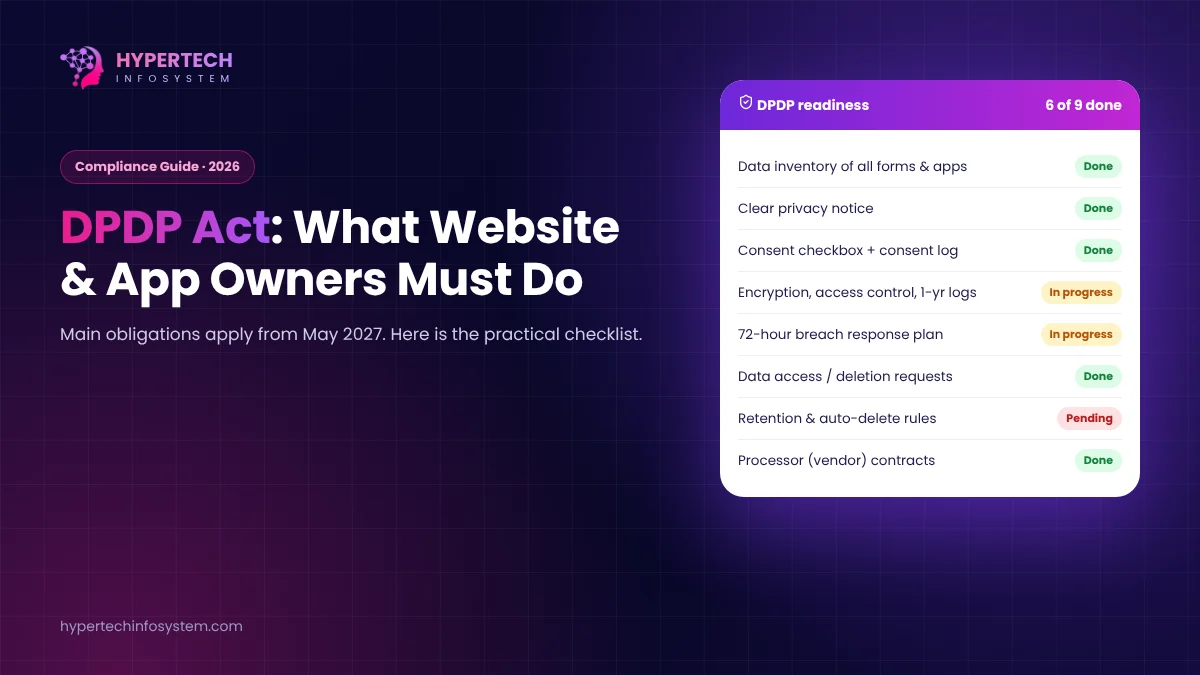
If your website has a contact form, your app has a login, or your CRM stores customer phone numbers, you are handling personal data, and India’s Digital Personal Data Protection Act, 2023 applies to you. The government notified the DPDP Rules, 2025 on 13–14 November 2025, and compliance is coming in phases. The main obligations apply from May 2027, which leaves about six months from today. This is enough time if you start now, and very little if you wait.
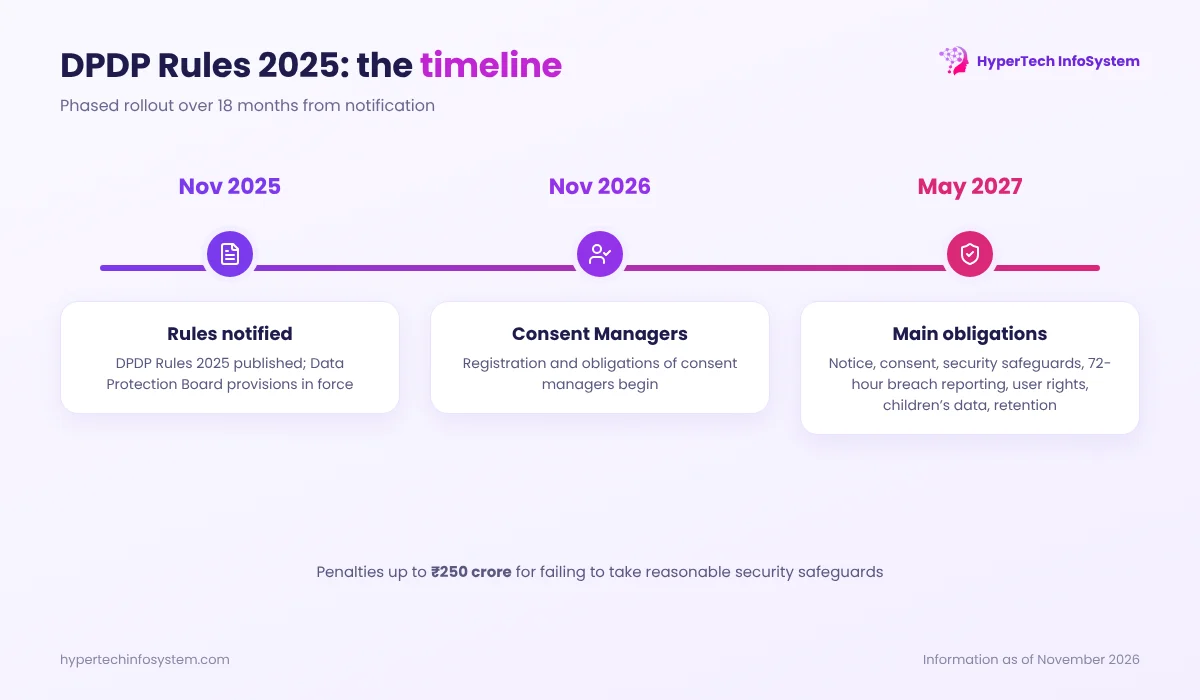
The timeline
- November 2025: Rules notified; provisions on the Data Protection Board came into force.
- November 2026: registration and obligations of Consent Managers.
- May 2027 (18 months after notification): core obligations, including notices, consent, security safeguards, breach reporting, data principal rights, children’s data and retention.
Key terms in one minute
- Data Principal: the person whose data it is, such as your customer, user or employee.
- Data Fiduciary: you, the business that decides why and how data is processed.
- Data Processor: a vendor who processes data for you, such as a hosting company, CRM provider, email service or payment partner.
- Consent Manager: a registered platform through which people can give, manage and withdraw consent.
The checklist for websites and apps
1. Know what data you collect
List every form, sign-up, checkout, chatbot, analytics tool and backup that touches personal data. Note why you collect each field and where it is stored. Remove fields you don’t really need. Less data means less risk.
2. Write a clear notice
Before collecting data, tell people in clear, simple language what you collect, why, and how they can withdraw consent or complain. The Rules expect the notice to be understandable on its own, not hidden in a long legal page.
3. Get valid consent where needed
Consent must be free, specific, informed and unambiguous, given by a clear action such as an unticked checkbox the user ticks. Withdrawing consent should be as easy as giving it. Keep a record of when and how consent was given.
4. Protect the data
The Rules list minimum security safeguards, including encryption, masking or tokenisation, access control, logging and monitoring, and backups. Logs must be kept for at least one year to help detect and investigate breaches. Practically: HTTPS everywhere, strong admin passwords and two-factor login, role-based access, regular updates and tested backups.
5. Be ready to report breaches
If a personal data breach happens, you must inform affected users without delay and send a detailed report to the Data Protection Board within 72 hours. Decide now who does what, and keep contact templates ready.
6. Respect user rights
People can ask to access, correct or erase their data, and to nominate someone to act for them. Publish a contact (email or form) and respond on time.
7. Delete data you no longer need
Set retention periods. Old enquiries, inactive accounts and outdated candidate resumes should not be kept forever. For some categories the Rules require notifying the person before erasing inactive data.
8. Children’s data
For users under 18, you generally need verifiable consent from a parent or guardian, and you should not track or target ads at children. This matters for education, gaming and social apps.
9. Contracts with vendors
Your hosting, CRM, email, SMS/WhatsApp and analytics providers are data processors. Make sure contracts cover security, confidentiality and deletion.
What’s at stake
The Act allows penalties of up to ₹250 crore for failing to take reasonable security safeguards, and up to ₹200 crore for failing to report a breach or for violating obligations related to children. Beyond fines, a data leak damages customer trust, which is harder to repair.
Where software helps
- Consent capture and consent logs built into forms and apps
- Admin panels with role-based access and activity logs
- Encrypted storage and automatic deletion of old records
- A self-service “my data” page for access and deletion requests
HyperTech InfoSystem helps businesses review and update websites, apps, CRMs and HR systems for DPDP readiness, from consent flows to security hardening. Book a meeting for a technical review. Related reading: background verification and DPDP.
This article is general information, not legal advice. Please consult a qualified legal professional for your specific situation.
Sources: Digital Personal Data Protection Act, 2023; DPDP Rules, 2025 (MeitY, notified 13/14 Nov 2025); law-firm analyses by Cyril Amarchand Mangaldas, Shardul Amarchand Mangaldas and Mondaq contributors.
0 Comments
No comments yet. Be the first to share your thoughts!
Leave a Comment
Your email will not be published. Comments appear after approval.