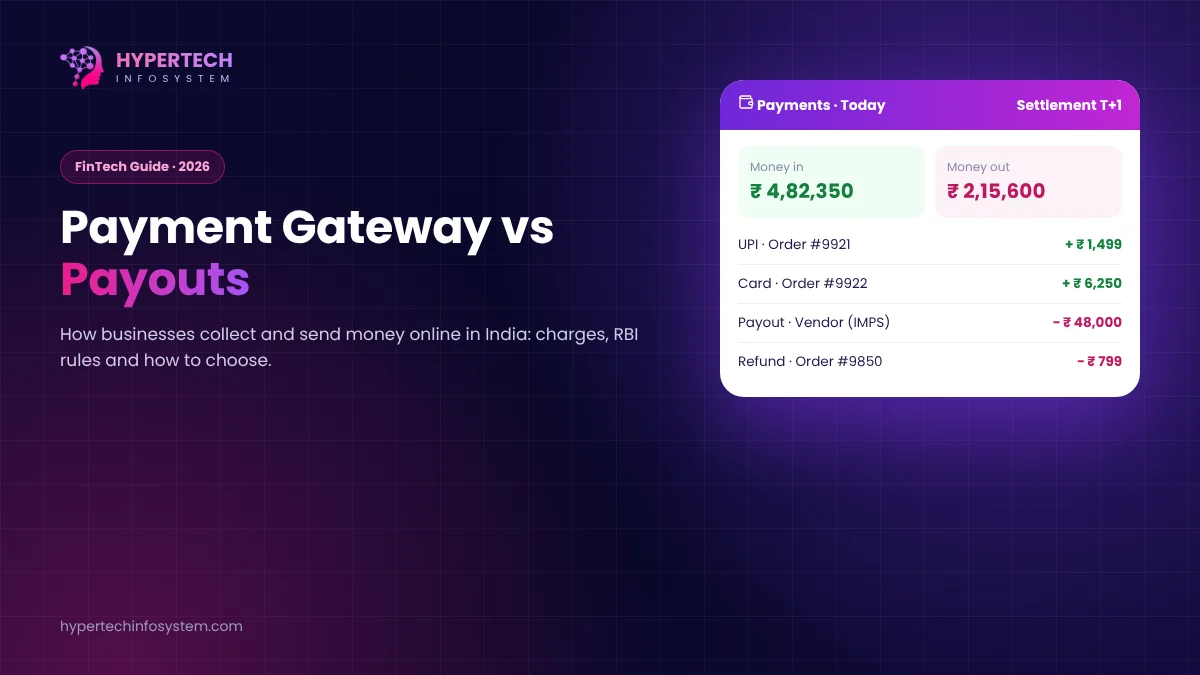
Every business deals with two flows of money. Money in: customers paying you for orders, fees or invoices. Money out: you paying vendors, delivery partners, employees, refunds or cashback. Many businesses get the first one sorted and still handle the second with a spreadsheet and manual bank transfers. Here is how both work, and what to look for.
Money in: payment gateways and aggregators
A payment gateway is the technology that takes a payment on your website or app and talks to banks and card networks. In India, most businesses use a payment aggregator (PA): a company that collects payments for many merchants, holds the money in an escrow account and settles it to you, usually the next working day (T+1).
The RBI’s Regulation of Payment Aggregators Directions, 2025 (15 September 2025) brought online, physical (point-of-sale) and cross-border aggregators under one rulebook. Non-bank aggregators need RBI authorisation and a minimum net worth of ₹15 crore at application, rising to ₹25 crore by the end of the third year. For you as a merchant, this mainly means stronger KYC during onboarding and more rules on how your funds are held. It also makes the provider’s RBI status worth checking before you sign up.
What collections cost
- UPI and RuPay debit cards: zero MDR at the network level since January 2020. Gateways may still charge a platform fee for their service. NPCI announced a 0.4% MDR on certain person-to-merchant UPI payments above ₹2,000, capped at ₹300, with small merchants receiving up to ₹1 lakh a month through UPI QR exempt. It was due on 15 October 2026 but was deferred, and as of mid-November 2026 no new date had been announced. Keep an eye on it if you collect large UPI payments.
- Credit cards, wallets, net banking and EMI: typically around 2–3%, depending on the provider and your volume.
- International cards: higher, often 3% or more.
- GST at 18% applies on the gateway’s fee, not on the transaction amount.
Money out: payout solutions
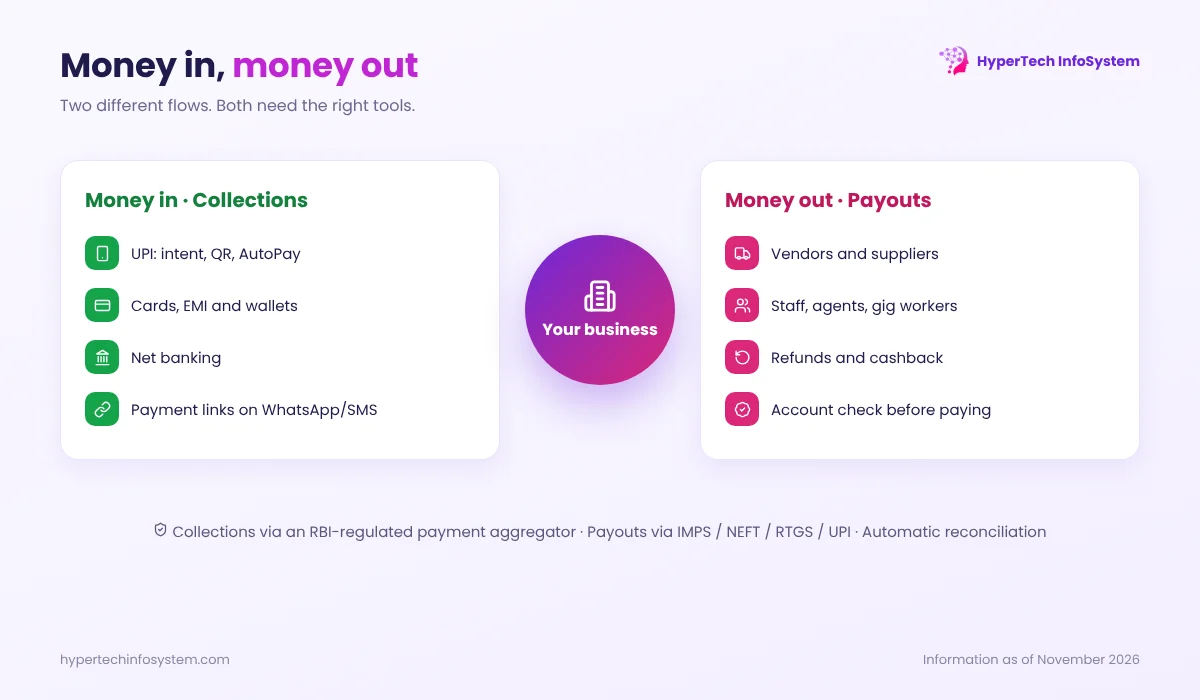
A payout platform lets you send money to many bank accounts or UPI IDs at once, through an API or by uploading a file, instead of entering each transfer in net banking. Common uses:
- Vendor and supplier payments, with approval workflows
- Salaries and incentives for field staff and gig workers
- Refunds and cashback to customers
- Commissions to agents, distributors and partners
- Loan disbursements and insurance claims
Payouts usually run on IMPS, NEFT, RTGS or UPI, with a per-transaction fee. Good platforms also check the bank account before paying (penny drop or name match), which prevents transfers to wrong or fake accounts.
How to choose a provider
| Check | Why it matters |
|---|---|
| Success rate | A failed payment loses the whole order, which costs more than any fee. |
| Payment methods | UPI (intent, QR, autopay), cards, EMI, wallets, net banking |
| Settlement time | T+1 is standard; same-day may cost extra |
| Full pricing | Setup fee, annual fee, platform fee on UPI, refund charges, GST |
| Reconciliation | Reports that match each settlement to your orders and invoices |
| API and plugins | Easy integration with your website, app, billing or ERP |
| Payout controls | Maker-checker approvals, beneficiary verification, limits |
| Regulatory status | RBI authorisation (or in-principle approval) for aggregators |
Common mistakes
- Comparing only the headline rate and ignoring failed payments and hidden fees.
- Manual payouts with no approval trail, which invites both errors and fraud.
- No automatic reconciliation, so accounts spend days matching UTR numbers.
- Storing card details yourself. Card data must be tokenised; leave it to your gateway.
Stripaye
Stripaye, our FinTech product, helps businesses manage payments, payouts and collections in one place. HyperTech also integrates gateways and payout APIs into custom websites, apps, ERPs and marketplaces, including reconciliation and dashboards. Book a meeting to discuss your payment flow.
Charges and rules change; confirm the latest pricing and regulatory status with your provider.
Sources: RBI, Master Direction on Regulation of Payment Aggregators (15 Sept 2025); NPCI announcement on UPI P2M MDR (Sept 2026) and deferral statement (13 Oct 2026), as reported by Business Standard and Inc42.


0 Comments
No comments yet. Be the first to share your thoughts!
Leave a Comment
Your email will not be published. Comments appear after approval.