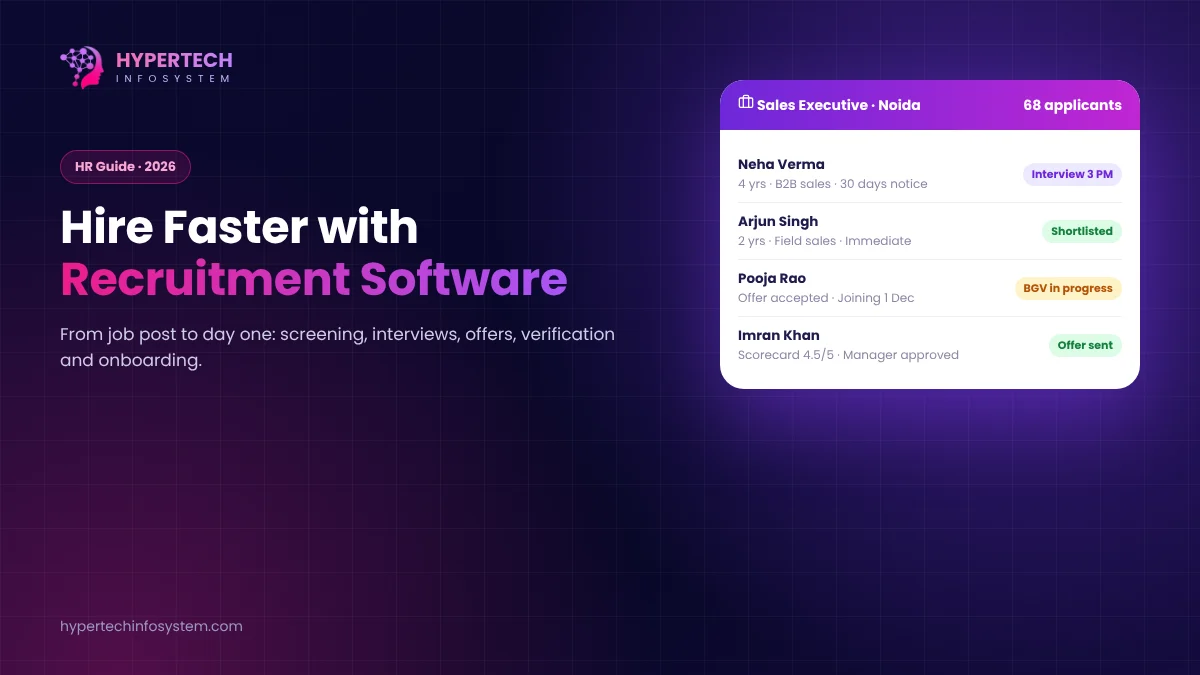
When a company grows from 20 to 100 people, hiring stops being an occasional task and becomes a process that runs every week. The tools usually don’t keep up: job posts on five portals, resumes in three inboxes, interview feedback in WhatsApp groups and offer letters edited from last year’s template. Good candidates accept other offers while you are still “collecting feedback”.
Where hiring time actually goes
- Reading resumes that clearly don’t match the role
- Coordinating interview slots between candidates and busy managers
- Chasing interviewers for feedback
- Re-typing candidate details into offer letters and HR records
- Collecting documents, one reminder at a time, after the offer
Almost all of this can be automated or at least organised.
What recruitment software (ATS) does
One place for every job and candidate
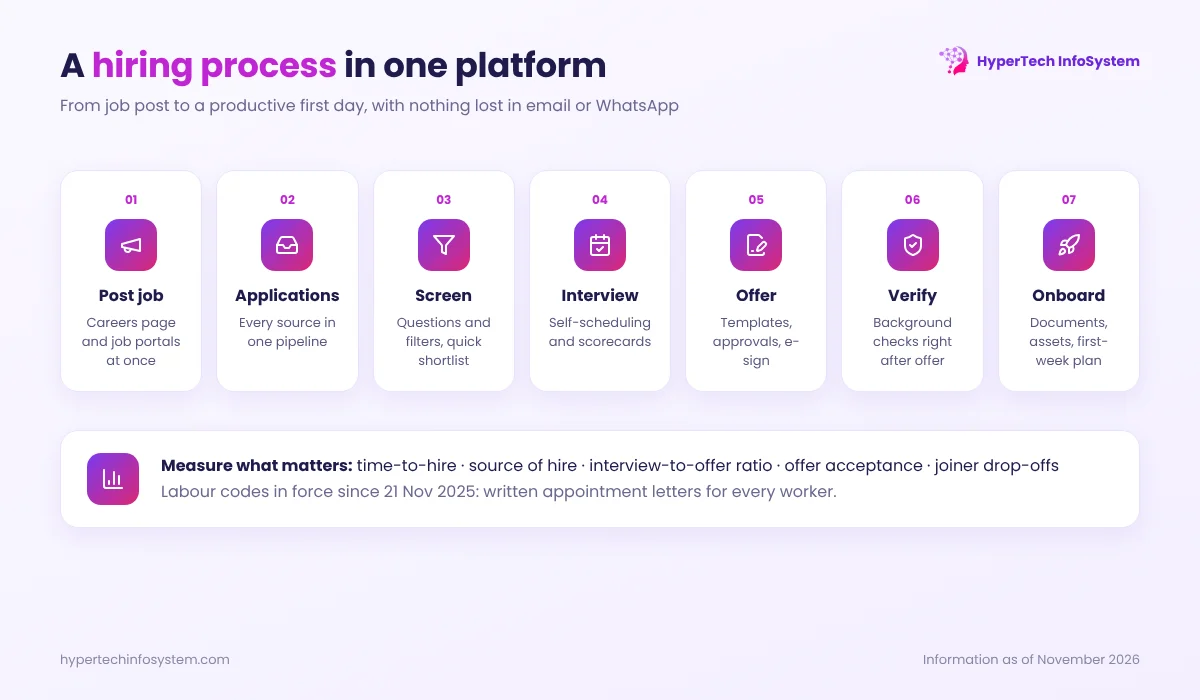
Post a job once to your careers page and job portals, and every application lands in one pipeline, whether it came from a portal, referral, email or walk-in.
Faster screening
Screening questions, filters for experience, location and notice period, and resume search let recruiters shortlist in minutes, not hours.
Interview scheduling and feedback
Candidates pick from available slots, everyone gets calendar invites, and interviewers fill a short scorecard right after the interview, so decisions are based on notes rather than memory.
Offers and approvals
Offer letters are generated from templates with the right salary structure and approved digitally before they are sent.
Candidate communication
Automatic updates by email or WhatsApp. Even a polite rejection improves your employer brand.
After the offer: onboarding and verification
Many companies lose joiners between the offer and day one. A digital onboarding flow keeps them engaged and saves HR a lot of follow-up:
- Secure online upload of documents (ID, address, education, previous employment)
- E-signature for offer letters, NDAs and policies
- Background verification started immediately after the offer is accepted
- Asset requests (laptop, email ID, access card) triggered automatically
- A first-week plan shared with the new joiner and their manager
The new labour codes make good HR records more important
India’s four labour codes, on Wages, Industrial Relations, Social Security, and Occupational Safety, Health and Working Conditions, came into force on 21 November 2025, replacing 29 older central laws. Among the changes HR teams should note:
- Every worker must get a written appointment letter, including fixed-term and contract staff.
- Working hours are capped at 8 hours a day and 48 hours a week.
- A wider, uniform definition of wages, which affects salary structures and statutory contributions.
- Social security coverage extended to gig and platform workers.
- Simpler, more digital registrations and returns, with central and state rules being notified in stages.
This is a big change, and details depend on central and state rules. Please work with your legal or payroll advisor. From a systems point of view, the lesson is simple: appointment letters, attendance, wages and employee records need to be accurate, consistent and easy to produce.
How to choose an HR platform
- Fits your hiring volume: a company hiring 5 people a month needs different tools from one hiring 200 field staff.
- Mobile-friendly for candidates: most applicants in India apply from a phone.
- Integrations: job portals, email/calendar, WhatsApp, background verification and payroll.
- Data protection: role-based access, secure document storage and deletion of old candidate data, in line with the DPDP framework.
- Reports: time-to-hire, source of hire, offer acceptance rate and joiner drop-offs.
Shigotoplus
Shigotoplus is HyperTech InfoSystem’s recruitment and HR platform, covering job posting, candidate search, background verification and workforce management. For companies with unique processes, we also build custom HRMS and onboarding portals. Book a demo and tell us how you hire today.
This article is general information, not legal advice.
Sources: Ministry of Labour and Employment notifications bringing the four labour codes into force (21 Nov 2025); reporting by Outlook, Tribune (ANI) and law firm updates.
0 Comments
No comments yet. Be the first to share your thoughts!
Leave a Comment
Your email will not be published. Comments appear after approval.