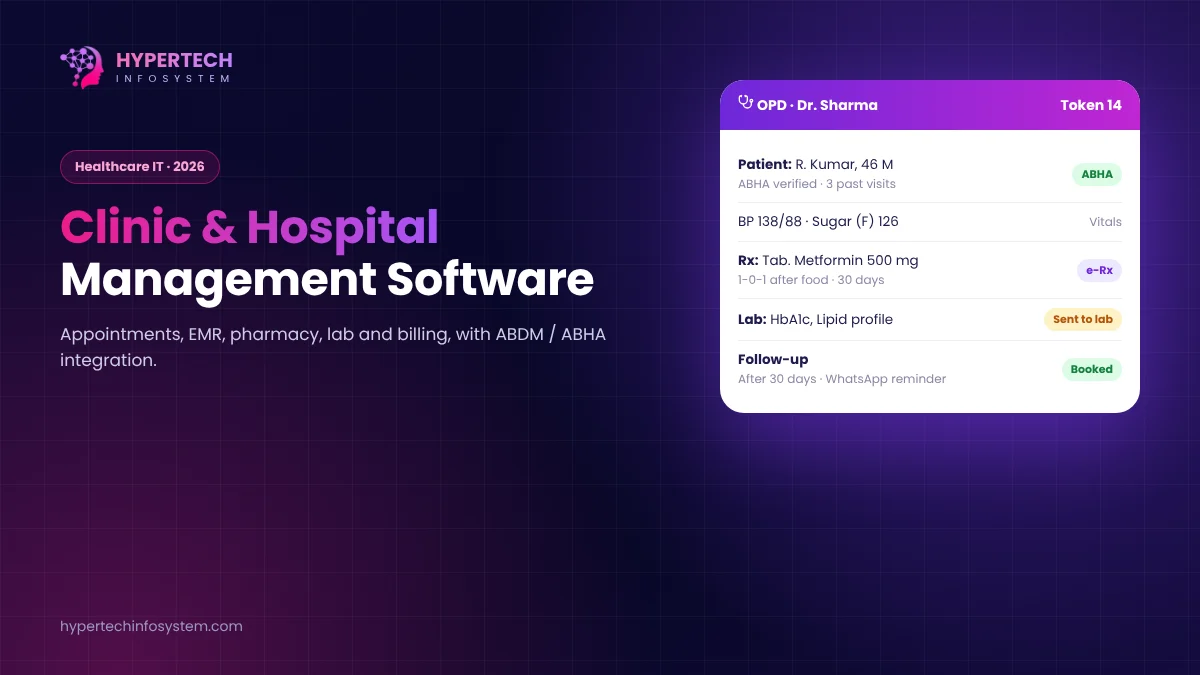
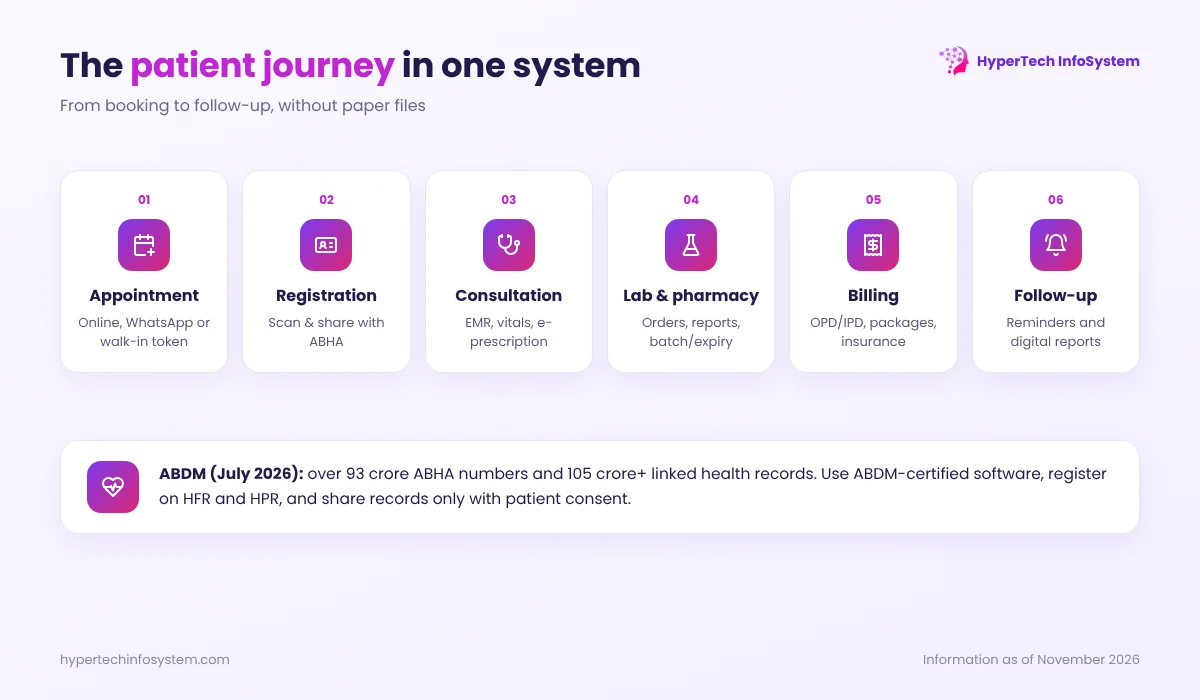
A patient sees a doctor for ten minutes. Around those ten minutes sit a dozen other steps: booking, registration, vitals, prescription, lab tests, pharmacy, billing, insurance and the follow-up call. When these run on paper and separate software, queues grow, files go missing and revenue leaks. A clinic or hospital management system (HMS) connects the whole journey.
Core features
Appointments and queue
Online booking on your website and WhatsApp, doctor-wise slots, token display and SMS reminders that reduce no-shows.
Registration
Quick patient registration, with the option to use the patient’s ABHA (Ayushman Bharat Health Account) to pull in their verified details.
Electronic medical records (EMR)
Complaints, history, vitals, diagnosis, notes and past visits on one screen, with templates by speciality.
E-prescription
Legible, printable or digital prescriptions from a drug list, with dose templates and allergy alerts.
Lab and radiology
Test orders flowing from the doctor to the lab, sample tracking, result entry and reports delivered to patients by SMS or WhatsApp.
Pharmacy and inventory
Stock with batch and expiry, purchase orders and billing linked to prescriptions.
Billing, packages and insurance
OPD and IPD billing, surgery packages, deposits, TPA and insurance claims, and GST where applicable.
In-patient management (for hospitals)
Bed management, admission, nursing notes, medication charts, OT scheduling and discharge summaries.
ABDM and ABHA: what they mean for you
The Ayushman Bharat Digital Mission (ABDM) is building a connected national health network. By July 2026, the Health Ministry reported over 93 crore ABHA numbers and more than 105 crore health records linked to them, with over 5 lakh health facilities registered on the Health Facility Registry.
For a clinic or hospital, ABDM integration typically means:
- Registering your facility on the Health Facility Registry (HFR) and your doctors on the Healthcare Professionals Registry (HPR)
- Using ABDM-certified software that can create and verify ABHA, use “scan and share” for faster registration, and link records to a patient’s ABHA
- Sharing records only with the patient’s consent, through the ABDM consent framework
- Becoming eligible for the government’s Digital Health Incentive Scheme (DHIS), which rewards facilities for ABHA-linked digital transactions (check current terms on abdm.gov.in)
When choosing software, ask whether it is ABDM-certified and which milestones (M1, M2, M3) it has completed.
Patient data security
Health records are among the most sensitive data a business can hold. Under the DPDP framework, you must protect it with reasonable safeguards, use it only for the purpose it was collected, and report breaches. In practice: role-based access (reception doesn’t need to read clinical notes), audit logs, encrypted storage and backups, strong passwords with two-factor login, and secure hosting in India. Our cybersecurity checklist covers the basics.
How to choose an HMS
- Fit for your size: a single-doctor clinic, a polyclinic and a 100-bed hospital need very different systems.
- Speed for doctors: prescription in under a minute, or doctors will go back to paper.
- ABDM certification and the milestones it supports.
- Integrations: lab machines, payment gateway, WhatsApp, insurance/TPA portals and accounting.
- Cloud vs on-premise: cloud is easier to maintain and access from multiple branches; check offline options for unreliable internet.
- Training, data migration and support hours, ideally including evenings and weekends.
Build or customise with HyperTech
HyperTech InfoSystem builds clinic, diagnostic and hospital software with appointments, EMR, pharmacy, lab, billing and patient apps, and integrates with ABDM through certified pathways. Book a meeting to discuss your facility.
Sources: Ministry of Health and Family Welfare / PIB updates on ABDM (May–July 2026); National Health Authority, abdm.gov.in (HFR, HPR, DHIS). General information, not legal or medical advice.

0 Comments
No comments yet. Be the first to share your thoughts!
Leave a Comment
Your email will not be published. Comments appear after approval.