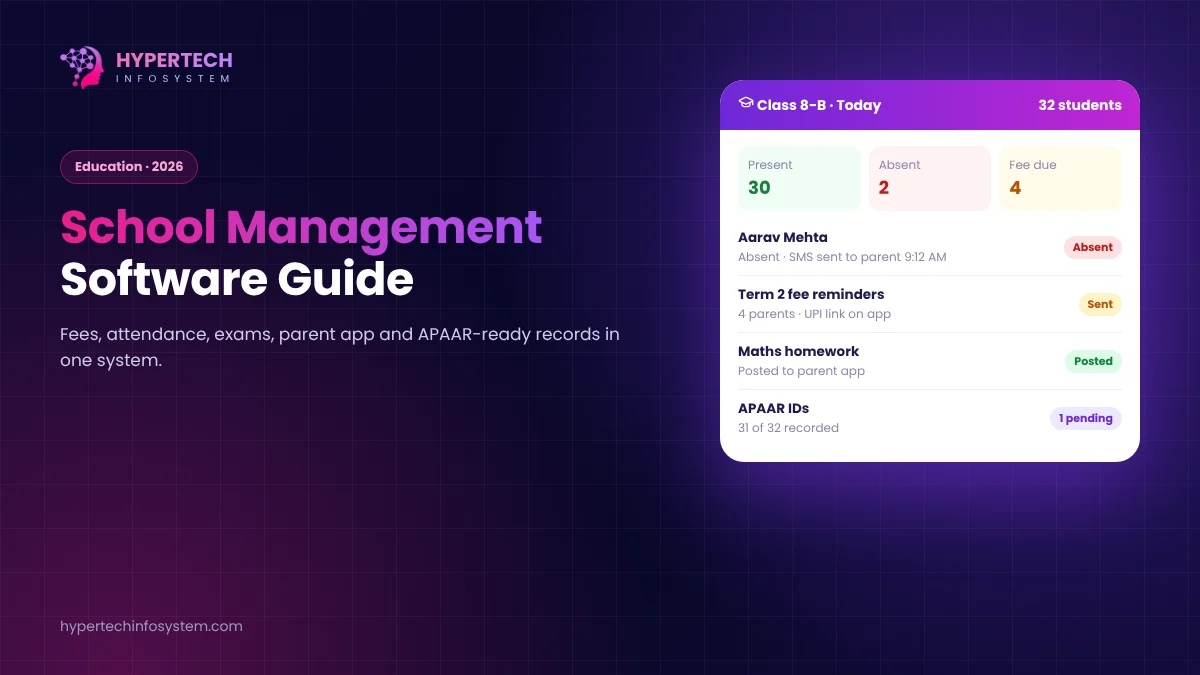
Ask a school office what takes most of their time and the answers are always similar: chasing fees, preparing report cards, answering parent calls and updating government portals. None of this is teaching, yet it fills the day. A school management system (often called a school ERP) puts students, fees, attendance, exams and communication in one place.
Modules a school actually needs
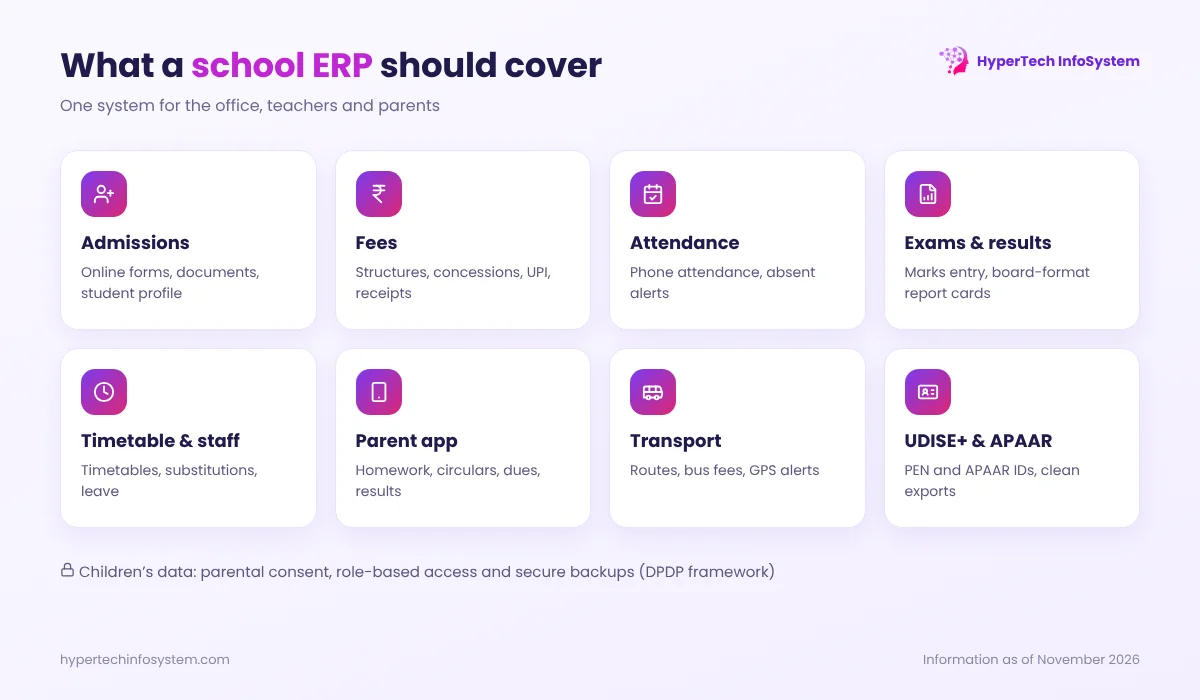
Admissions and student records
Online enquiry and admission forms, document upload, and one digital profile per student from admission to leaving certificate.
Fee management
Fee structures by class, concessions, late fees, online payment by UPI and cards, automatic receipts and reminders. Defaulter lists are generated in seconds instead of days.
Attendance
Quick class-wise attendance on a phone or tablet, with an automatic SMS or app alert to parents when a child is absent.
Exams and report cards
Marks entry by subject teachers, automatic grade calculation in your board’s format, and printable or digital report cards.
Timetable and staff
Class timetables, substitutions, staff attendance and leave.
Parent app
Homework, circulars, fee dues, attendance, results and a photo gallery, so parents check the app instead of calling the office.
Transport
Routes, stops, bus fees and, if needed, GPS tracking with “bus is near” alerts.
APAAR, UDISE+ and keeping records ready
Under the “One Nation, One Student ID” initiative, schools create a 12-digit APAAR ID for each student through the UDISE+ portal, after taking the parent’s consent, and it appears in the student’s DigiLocker. As of July 2026, the Ministry of Education reported over 26 crore verified APAAR IDs. CBSE has also started using APAAR IDs in board exam registrations for senior classes.
A school ERP can’t generate APAAR IDs itself (that happens on UDISE+), but it should store each student’s PEN and APAAR ID, keep names and dates of birth consistent with Aadhaar to avoid mismatches, and export the data you need for UDISE+ updates. Clean records save a lot of last-minute stress.
Student data needs extra care
Schools hold sensitive data about children: names, addresses, photos, health notes and parents’ phone numbers. Under India’s DPDP framework, processing children’s data generally needs verifiable parental consent, and tracking or targeted advertising aimed at children is restricted. Choose a system with role-based access (a class teacher sees only their class), activity logs, secure hosting, regular backups and the ability to delete old records.
How to choose
- Ease of use for teachers: if attendance takes more than a minute, it won’t be used.
- Your board and report card format (CBSE, ICSE or state board) supported without workarounds.
- Payment gateway integration with automatic reconciliation of fees.
- Parent app quality on low-cost Android phones, and in the local language if needed.
- Data migration and training included in the price.
- Support during admission season and exams, when you need it most.
- Data ownership: you can export all your data at any time.
Ready-made or custom?
A single school with standard processes is usually well served by a good ready-made ERP. School groups, coaching institutes with batches and test series, or colleges with complex fee and course structures often benefit from a customised system. Our article on custom vs ready-made software explains how to decide.
Talk to us
HyperTech InfoSystem builds school and institute management systems with fee collection, parent apps, exams and reports, designed around how your office works. Book a demo.
Sources: Ministry of Education / PIB factsheet on APAAR (“One Nation, One Student ID”, July 2026); CBSE circulars on APAAR implementation; DPDP Act 2023 and Rules 2025 (children’s data).

0 Comments
No comments yet. Be the first to share your thoughts!
Leave a Comment
Your email will not be published. Comments appear after approval.