India now has more than 2.23 lakh DPIIT-recognised startups (as of March 2026, per the Ministry of Commerce), and many more founders working on ideas they haven’t registered yet. The ones that last usually have one thing in common: they learned what customers wanted before spending most of their money. That is the job of a minimum viable product (MVP).
What an MVP is, and what it isn’t
An MVP is the smallest version of your product that solves one real problem well enough that people will use it, and ideally pay for it. It is not a cheap or broken version of your dream app. It is a focused one.
A food delivery MVP doesn’t need loyalty points, three payment wallets and a chef rating system. It needs a menu, an order button, payment and delivery tracking that works every time.
Step 1: Validate the problem first
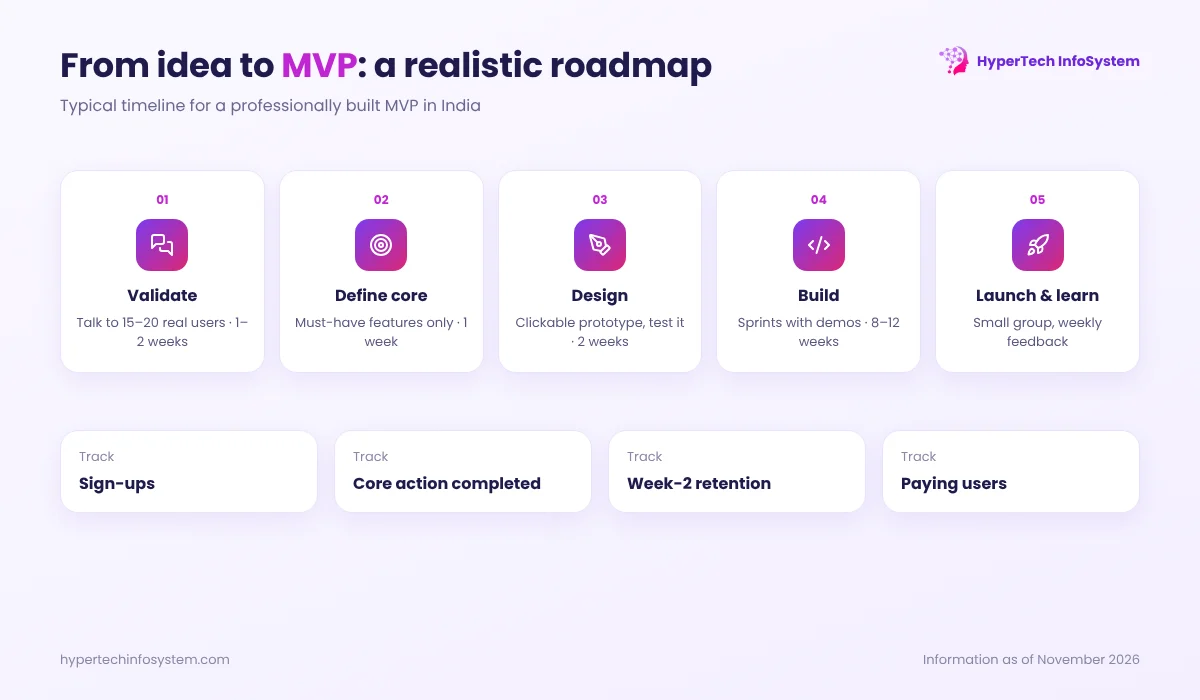
Before any code, talk to 15–20 people who would actually use the product. Don’t pitch; ask how they solve the problem today, what it costs them and what annoys them. If nobody is bothered enough to have a workaround, think again. A simple landing page with a “join waitlist” button and a small ad budget can also tell you a lot in two weeks.
Step 2: Pick the one core job
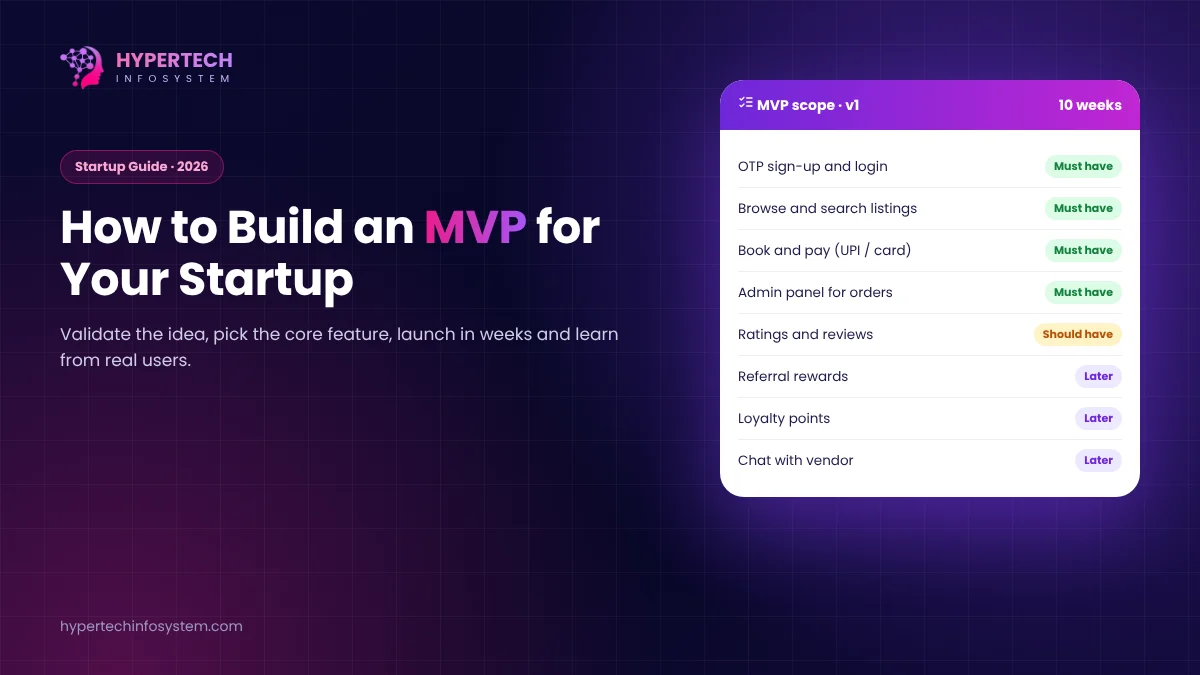
Write down every feature you want, then mark each one as:
- Must have: the product doesn’t work without it
- Should have: important, but users can live without it for three months
- Later: nice ideas for when you have users and revenue
Your MVP is the “must have” column, plus a basic admin panel so you can run the business. Be strict. Every extra feature adds weeks.
Step 3: Design before you build
Create clickable screens (wireframes or a Figma prototype) and show them to the same people you interviewed. Changing a screen in design takes an hour. Changing it after development can take a week.
Step 4: Build in short cycles
A typical MVP takes 8–12 weeks of development, built in 1–2 week sprints with a demo at the end of each. Choose proven technology so you can hire and scale later. For mobile apps we usually recommend Flutter, which gives you Android and iOS from one codebase; see our Flutter vs native comparison. Use ready services for login (OTP), payments, email and maps rather than building them yourself.
Step 5: Launch small and measure
Launch to a small group first: early sign-ups, one city or one customer segment. Track a few numbers that show real value: how many sign up, how many complete the core action, how many come back in week two, and how many pay. Talk to users every week. Then decide: improve, add the next feature, or change direction.
What does an MVP cost in India?
These are indicative ranges for professional development:
- Simple web app or single-platform app: approx. ₹3–6 lakh
- Android + iOS app with admin panel and payments: approx. ₹6–15 lakh
- Two- or three-sided marketplace (customers, vendors, delivery): approx. ₹12–25 lakh+
Also budget for hosting, third-party services (SMS/OTP, maps, payment fees), app store accounts and at least three months of improvements after launch. Our guide on mobile app development cost goes deeper.
Mistakes founders often make
- Building for “everyone” instead of one clear first customer.
- Spending the whole budget on version one, with nothing left to improve it.
- Choosing the cheapest freelancer, then rebuilding everything six months later.
- Not owning the source code, domain and app store accounts.
- Waiting for “perfect” before showing anyone.
Build your MVP with HyperTech
We help founders go from idea to a working MVP: problem workshop, feature prioritisation, design, development and launch support, with full code ownership. Book a free product consultation and bring your idea, even if it is just a page of notes.
Sources: Ministry of Commerce and Industry statement on DPIIT-recognised startups (April 2026). Cost and timeline figures are indicative estimates by HyperTech InfoSystem.
0 Comments
No comments yet. Be the first to share your thoughts!
Leave a Comment
Your email will not be published. Comments appear after approval.